Friday, December 7, 2012

Resistance to Change: Stumbling Block to Church Vitality


Do not say, 'Why were the former days better than these?'
   For it is not from wisdom that you ask this.
-Ecclesiastes. 7:10

This week, fresh from vacation, (it was wonderful, thank you) I've been pondering resistance to change. It may be the single most significant stumbling block to our future vitality. There are many factors, but let's explore just a few to see if they resonate with you in your setting:

Connection to the Old Way: We feel more comfortable with things the way we have grown used to them. In addition, individual tolerance for change varies depending on self-esteem, past success in negotiating positive change, a life time of impressions about change, conviction as to the need of change, and the degree to which one has a firm unchanging place on which to stand. Or stated differently, change is related to a person's / congregation's / committee's / association's / conference's general sense of security. Change, even good and necessary change, is difficult. Successfully negotiating change can happen when you are able to exercise what my Zen friends would call "beginner's mind"; that is, to be able to look at something with fresh eyes and leave your preconceived notions (connections) behind.

Identity: If ones sense of security and personal identity are related to something that is changing, change will be resisted more. Indeed, the more a particular change renders obsolete ones learning or ability to function, the stronger the negative reaction to it.

Concern about Skill Sets: This is a fear seldom admitted out loud, but for leadership, change in organizations necessitates changes in skills, and some people will feel that they won't be able to make the transition very well. They may thus resist change on that basis alone. Moreover, it can result in early or unexpected transitions, as those feeling unequipped may leave a position for which they are otherwise well matched.

Too Much, Too Fast: As Alvin Toffler states in Future Shock, change is difficult to deal with when it comes to fast, too hard, or unexpectedly. Given that we have been stuck in a bit of a time warp for the past four decades, this has not been a problem in most of our churches, although as the pace of change accelerates, it could be. Then again, has your church tried even small changes like new music? Projection screens? Different times or days for worship? Perhaps 'small' is a relative thing.

Depressed? Angry? Confused?

Yeah, join the club. But I think it is quite necessary to understand what's holding us back before we can get free of it. In my work with local churches around visioning, a fairly consistent pattern emerges: We're really good at visioning, at writing mission statements, at saying who we are or who we want to be. But moving from vision to action is the difficulty. Too many of us keep repeating the visioning process, wondering when change will happen, failing to acknowledge the stumbling blocks before us that must be dealt with before beneficial change is possible.

We say we are a God is Still Speaking church, that there is more to learn and discern. Indeed, the preamble to our UCC constitution states: "It affirms the responsibility of the Church in each generation to make this faith its own in reality of worship, in honesty of thought and expression, and in purity of heart before God."

I transited the Panama Canal last week. As I stared down at the huge locks that open and close as ships pass through, it would be easy to see them as gates preventing movement. But, in truth, the gates facilitate passage. They're not meant to hold something back, but to get it to the right level (or place) so that forward motion is possible. And so I wonder, how is your setting stuck? Do you see an un-transit-able passage ahead blocked by closed gates, or is it possible to name the gates and deal with them so that they will open once our institutional water levels equalize? Can we give our 'stuckness' an honest look, and find opportunities for movement?

It's not impossible. It's happening in some of our congregations already. If you're ready to move on, be in touch. Lynn, Pam, and I have set aside time to be with you to help. It's one of the ways that we're living into our mission statement:

Equipping congregations for Christ's ministry and mission
today and tomorrow.

Peace,

Jim     

Monday, May 28, 2012

Memorial Day...

I'm not sure when the 'mission creep' happened - but these days I hear Memorial Day referred to as a day for remembering all who have died. Call me old fashioned, but as a veteran, I prefer to honor those who gave all in service to their country. All gave some, some gave all.

No one loves war any less than those you send to fight it - because only they know completely the costs paid. To my brothers and sisters who served - thank you. To those who gave their lives - we salute you. To those who came home with physical or emotional wounds which will never fully heal - we will not forget your sacrifice and pledge to provide you the best care possible.

Thursday, May 24, 2012

Stuff and Baggage


Summers, especially as I look out the window wistfully today, are both wonderful and short. We each have to find our own way to partake in the awesomeness that is summer in Vermont. For Lynn and I, that means kayaking our ponds and lakes, and camping. We have a camping trailer we pull behind my truck and we steal weekends away when we can, even though it usually means racing to Randolph Center on Sunday morning for church from wherever we’re situated. When possible, we enjoy being close to water, and an evening campfire. It’s not roughing it, by any means, but being ‘away’ and close to nature and the primal forces of fire and water restore my soul. 

It is time for a new camper this year, and we’ve had one on order that we’ll pick up this weekend. That means for the last couple of weeks we have been emptying out and cleaning our old camper that we’re trading in. Oh, the stuff we found! Emptying a compartment, I found a box full of stuff that had been placed in this trailer from its predecessor years ago – and hasn’t been touched since. Guess we really needed that stuff.

And that got me to thinking. How much ‘stuff’ are our churches carrying around, taking up space and effort and time and resources and not doing anything to further our ministries and mission? I suspect we all have some things, in one degree or another. For some of our congregations it might be the building itself – of a size which could support a worshipping community of 250 in which today’s congregation of 20 seems almost lost. And what sort of a drag is supporting that building, and how does that baggage steal energy and resources away from mission and ministry?

Now it’s quite possible that a congregation which today stands at 20 active participants can be revitalized into a worshipping community of 60 or 75. In fact, that’s an important part of our vision for the future. But it’s a lot less likely with the building hanging over their heads. And even with a successful rebirth – does the new congregation need a 200 year old building that’s still three times as big as it needs to be?

You know what I long for? The day that we stop using the words church and building as synonyms. We can be church, we can do church, we can birth a church, we can renew a church – and none of those things requires a building. Our buildings are a tool – and if that tool feels more like baggage that you are dragging around - or is dragging you around – well, that’s not a very useful tool.

Here’s some homework for you. Take a close look at your church’s budget, and figure out how much of it supports your building, how much supports staff, and how much goes to mission and ministries. You might be surprised at how much you spend to support and maintain your building. Money that could ensure your pastor’s compensation package meets Conference guidelines, or that your other staff earn a livable wage, or additional support you could give to your missions.

I know it’s hard to separate our hearts from our heads when discussing our buildings. They have a hold on us that’s difficult to look past. And that’s the problem – they may well hold us in the past, and prevent some new thing that could happen in our midst.

At a gathering of Conference staff to talk about church vitality and new church starts, I heard a startling thing: A majority of all new church starts have put language in their constitution that prohibits the ownership of a building. If they have a worshipping community of 50, they rent a space for 50. If they grow to 150, they move to a space which will hold that. If they later shrink, they can adjust again. How liberating. They know something we could stand to learn.


Wednesday, January 26, 2011

Where is Our Mission Field?

I've been spending some time this week digesting the Pulse of Vermont Quality of Life Study 2010. If you're not familiar, it's a survey done by the Vermont Business Roundtable, this being the fifth analysis since 1990. There are many interesting things to be found inside. If you'd like to read or download the report, click here.

One of the things that surprised me was that more Vermonters would be willing to pay an additional $250 in taxes per year for the preservation of open land or for better public transit than to improve our schools. At 42%, the people willing to pay extra taxes to support better schools was the lowest level ever recorded by the survey.

Only 13% of those surveyed thought life in Vermont is getting better, also the lowest ever recorded.

But here is where I'm doing most of my pondering. One of the sets of questions was about the level of confidence in Vermont based institutions. Colleges and Universities scored the highest, followed by hospitals, banks, public schools, and major Vermont corporations. The bottom three? Organized religion, courts and the legal system, and, at the bottom, the government in Montpelier.

Really? We rank lower than Vermont Yankee? Whew.

It used to be fashionable to think of our congregation's mission field as somewhere 'away'. Some far off land, Africa or the Middle East perhaps, where we could send missionaries, or aid workers, or money to improve the life of those less fortunate. And that's good work we should not abandon, but it's not our only mission field.

A Pew Research survey a few months ago said the Hew Hampshire and Vermont were the 'least religious' states in our country. And we've just learned our congregations, associations, and conference are considered only marginally more trustworthy than our state government, and less than banks, IBM, and our health care system.

Here's a (not so little) secret I'll share with you. Your mission field? It's right outside your door. It's on your street, in your neighborhood, at your local market, across your community and our state. As we face the declines we all have been experiencing head on, and recognize that change is not only desirable but imperative to our survival, perhaps one of the ways to do that would be to put some of the energy and good will we focus on world mission a bit closer to home. We should not abandon our world mission efforts, which are helping to change our world, but where could we also be a force for good locally? Perhaps at our local food shelf. Or homeless shelter. Or in communion with other local non-profit aid agencies. Or by providing free community dinners. Or by increasing your support for, and highlighting the work done through the Conference on your behalf in support of low income Vermonters, or summer lunch programs. By helping those close to home, while demonstrating to your neighbors that our version of the church of Jesus Christ still has relevance, purpose, and worth.

The mission work and the ministries of your congregation are more needed than ever, and the cost to do it higher. It's no coincidence that our last two Conference church growth events have centered on living and then telling our story. And we have some additional work to do, helping others to understand what we do and why we do it.

Let's get to it.

Peace,

Jim

Thursday, December 2, 2010

Advent, Introverts, and John the Baptist


Those of you who have seen me give budget presentations at Conference Annual Meeting may not believe this, but I really am an introvert. Crowds tend to drain my batteries, not recharge them. A week long silent retreat I took a couple of years ago was a treat, not torture. I tend to internalize and be introspective, and when my sermons come out after a week of mulling, they do so fully formed.


Advent is the perfect time for introverts. We are invited, at the beginning of our church year, to ponder, reflect, consider as we await the coming of the Christ Child. We dissect once again the meaning of metanoia - does it mean simply to repent, or something more - to literally turn around, turn away, from that which is harmful, from that which separates us from our Creator?


And then, in the midst of our (quiet) internal discussion and debate, comes boisterous and challenging John the Baptist. What are we to do with you John? Uncompromising, unkempt, unabashed, and unapologetic. There can be no mistaking language like "You brood of vipers!" He demands our attention; he also demands our action.


The picture above (originally composed by Will Humes) was my idea for the Conference Christmas card this year. Alas, all of the rest of the staff vetoed my idea. With apologies to Tom Hanks, it's probably just as well. We don't really want John in our face, do we? We don't want to be directly challenged, do we? We don't want to be told that we may have wandered off our path a bit, do we?


John the Baptist shakes us from our quiet Advent strains of O Come, O Come Emmanuel, pokes us with a sharp stick, and makes us sit up and take notice. It's not all warm and fuzzy. It's not only about crèches and angels and a star in the East. It's about much more than that...


Whether your Advent be one of silent reflection, or something a bit more extroverted, I hope you find the space to both contemplate and act. We are great thinkers in the United Church of Christ: My prayer for our Advent season is that we are more than just a voice crying out in the wilderness - that we are also inspired to do. "Do" what needs to be done for ourselves, and "do" what needs to be done for our hurting world.


Peace

Jim

Sunday, June 14, 2009

Pictures from the past - Generators large and larger.


I’ve been spending some time lately going through some old pictures and thinking about the enormity of the task of taking these photos and scanning them into my computer to preserve them. Not that I think 20 years from now we’ll be using compact discs or flash drives to store photos, but who knows.


I spent 20 years in the US Navy. Everyone knows what that is. I served in a smallish subset of the Navy called the Seabees, the Navy’s construction and humanitarian aid arm. There are about 12,000 Seabees on active duty these days – but there were over 300,000 of them during World War II, bulldozing their way through the Pacific theater, building bases, airstrips, docks, fuel depots, and generally supporting whatever efforts were needed to advance toward Tokyo. In between conflicts, the Seabees focus on humanitarian aid missions.


Of those 20 years, about half of it was spent in special program (only about 40 of us) within the Seabees called the Mobile Utilities Support Equipment (MUSE) Program. It’s purpose was to supply shore based utility services to Navy facilities world wide where there were shortages, for example, a naval base that didn’t have enough electrical capacity to provide power to ships when they were in port.

I’ve scanned in a few pictures from those days, which will serve as today’s “Photo Blog.”


Here are two 1000 kilowatt diesel generator sets that I installed (with a 4 person MUSE team) in Sasebo Japan in 1984. Each generator had an Alco Diesel engine of about 1400 horsepower. Alco was once the American Locomotive Company, and designed these engines for locomotive use, although they proved reliable in generator service as well. These generator sets, although attractive, were not particularly well made (by a contractor in Florida) and we usually spent several days working out the kinks during any new installation. These generators produce power at 4,160 volts, which was either bumped up for transmission, or transformed down for distribution. MUSE generators almost always produced power at that voltage, and were often accompanied by a portable MUSE electrical substation to provide the voltage shift.


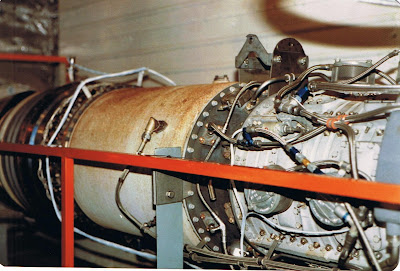
The coolest and most technically intricate generators in the MUSE fleet were the generators driven by gas turbine engines. We had two very different models; a 750 KW generator set driven a Solar Gas Turbine engine, and this one, a 2000 KW generator driven by an Allison Gas Turbine engine. The engine in this generator set, a model we called the 501KB, was also used in turboprop aircraft such as the C-130 cargo plane (in which it had the model designation T-56). For our use, instead of driving the propeller, the front shaft went through a reduction gear-box and then spun a generator. It was a complex unit, using a small 150 hp gas turbine as the starting motor for the larger engine. These were built by Morrison – Knudson in North Carolina, who built many different MUSE generator plants, in the days before electronics ruled. Designed in the 1970’s, they required a complicated panel of over 50 relays and switches just for the starting sequence. This picture is from Christmas Day 1982, as a team of us were dispatched to Mare Island Shipyard to provide emergency power as the base had suffered damage to its electrical transmission tower during a storm.


Here is one of the three control panels for the generator. The generator included a fire suppression system. These generators were not what you would call fuel efficient, using 250 gallons of jet or diesel fuel per hour at full load. But that wasn’t the point – they were the most power-dense generator we had: 2,000 KW of power in a highway legal trailer. It could get almost anywhere very quickly.


Here is a shot of the engine. The starting system included a complicated sequence to avoid ‘compressor stall’, which can result in melted turbine blades, which is, ummm, not good.


Here is a picture of me and Barney Baker taken at Mare Island on Christmas 1982. Barney was a good friend and mentor.

One of my favorite deployments during my MUSE years was the trip to Key West Florida in early 1982. We took one of the 2000 gas turbine generator sets (same as above – we had 12 of the trailer mounted versions) and a MUSE substation to Florida, mounted it on a WW II era landing craft, and supported the ‘shock test’ of a new class of ship.

What is a ‘shock test’? It’s when you take a new class of ship, bring it a few miles off shore, and then detonate explosives underwater that are progressively larger and closer to see how the ship reacts. It’s a sort of stress test for ships. What made this test unique was that it was the first shock test performed on a nuclear powered surface vessel. We were there (don’t laugh) in case the reactor scrammed, and the emergency generators failed also. We were supposed to come alongside, run and connect cables into the ships electrical system, and provide power for the reactor emergency core cooling system (ECCS) and other critical systems. We practiced the drill a few times before the actual tests. It also meant that we had to be very nearby during the test, once we were closer than the ship to the explosives. Which meant all of our ‘stuff’ had to stay together too. Which it didn’t. Which is another story.

Well, we’re getting long here, so let’s call this generators part one. More next time.

Wednesday, November 26, 2008

Happy Thanksgiving!

What follows is a reprint of my lead article for the Vermont Conference's weekly email newsletter, E-KIT, published November 26, 2008.

The current financial situation (or crisis, if you're following your 401(k) value closely) has resulted in many of us feeling less certain about our future. As often happens in these circumstances, folks "pull in the reins" and reduce spending on non-essentials. The spike of oil prices above $140 a barrel earlier this year caused some frantic number crunching in our local churches as the cost to heat sanctuaries this winter seemed unbelievably high. Other congregations are already bracing for reduced giving in the coming year.

To be honest, I'm not really a "glass half full" or "glass half empty" person. Troubleshooter that I am, I'm more of a "the glass is twice as big as it needs to be" person. But having said that, I also know that our God is a God of Abundance, not scarcity! And God will fill our glass - how big it is, is up to us. And we, as Stewards of God, must give from that spirit of abundance, not from a place of fear.

This week there were plenty of reminders of people who know this to be so. An Associated Press article provided many reasons to be hopeful, including:

· In Seattle, Boeing Co. employees tripled their cash donations this year to Northwest Harvest, operator of Washington's largest food bank. And every week, Northwest Harvest spokeswoman Claire Acey says, companies call to say their employees have decided to skip their holiday party and buy food for the hungry instead.

· Contributions to American charities have increased during 39 of the past 40 years in today's dollars, and a change in the tax laws _ not the stock market crash _ can be blamed for the drop in 1987, said Melissa Brown, associate director of research for The Center on Philanthropy. Between 69 and 72 percent of people give routinely, she said.

· A survey released this week by Federal Way, Wash.-based World Vision indicates that 2008 could actually be a better-than-usual Christmas for the nation's charitable organizations. The telephone survey, conducted in late October by Harris Interactive, found that seven in 10 adults plan to spend less money on holiday presents this year, but about half say they are more likely to give a charitable gift than a traditional present such as clothing or an electronic toy.

Now, I'm not a Pollyanna, and I know we face some difficult decisions in both our local churches and at the Conference about our expectations for income in the coming years. But I would encourage you to faithfully explore (it's amazing how different the world looks through the prism of the Spirit) new and exciting ways to be "church", and not to spend too much time worrying and bemoaning our future. The worrying doesn't help - and the time spent moaning is better spent in prayer.


Jim

Tuesday, November 11, 2008

Reflections on Veterans' Day…


I have had an uneasy relationship with Veterans' Day my entire adult life. Although I gave 20 years to the service of my country in the Navy Seabees, the label of Veteran is not one I wear without some discomfort. Indeed, due to injuries to my knees while on active duty, I could also correctly be called a disabled veteran, a moniker with which I am even more uncomfortable.

It is not that I am ashamed or embarrassed of my service. The exact opposite is true. I had, by nearly any measure, a successful and rewarding career. A Chief Petty Officer in 8 years, a Master Chief in 17, and half of my career spent in a specialized program supplying utilities to naval facilities worldwide.

And yet.

And yet, my internal pictures of Veterans are, for example, the grizzled survivors of World War II, a group whose numbers are significantly decreasing daily, and of which my father is a part. Those who saw things which should not be seen, and did things you shouldn’t have to do. And when they came home, they locked it all away and went on with their lives as if it never happened. Recent works recognizing “The Greatest Generation” have provided the children of those men (and women) with amazing stories of both horror and heroism they had never heard before.

Or perhaps those who served in Korea, the ‘forgotten’ war. Or those who served in Vietnam. Vietnam Veterans, in particular, were treated shabbily by the country they served admirably when they returned. Many of them still wear the scars of that conflict, whether visible or not.

More recently, we have those who served in the first Gulf War, and those who serve as I type.

Those are the men and women I think of when I hear the word Veteran. To be included in their number seems almost a sham. Did I do some dangerous things during my service? Certainly. But nothing that compares to what millions of others have done, sacrifices paid with body parts, damaged psyches, and all too often the ultimate sacrifice for a sometimes ungrateful nation.

I have many fond memories of my service with the Seabees. There was the Christmas I spent at the Mare Island Shipyard with Barney Baker and others as we provided emergency power to the base after the failure of a transmission tower. The day Lynn and Joe Maynard pinned Chief Anchors to my collar for the first time. The 7 months in Haiti, building a 5.5 mile road around Port-au-Prince, and my crew who delighted in giving their meager off time to rebuilding local schools and orphanages, as Seabees are want to do. The three years Lynn, I, and the kids spent in the Philippines, surviving five typhoons, an earthquake, two coup attempts, and finally, the eruption of Mount Pinatubo.

And the month spent in Homestead after Hurricane Andrew. We were part of a small Seabee Unit at the Mayport Naval Station in 1992 when Andrew devastated south Florida. The next day, the Commanding Officer of Naval Station Mayport called and said simply, “Go south. Help people.” Best set of orders I ever received. And we went; clearing roads, providing temporary roof repairs, distributing food and healthcare, repairing electrical systems.

All good stuff of which I am very proud, but which seems deficient when compared to the acts of others. And so, on this Veterans' Day, I hope all Americans will honor those who have to ably served their country. And a day I will wear the label of Veteran proudly, but humbly.

Blessings to all of you,

jim

Saturday, April 12, 2008

How Advertising Distorts Reality and the Harm it Causes...

Advertising, particularly since the advent of television, has sought to shape not only what we buy, but how we think, and indeed our impression of what is good or beneficial. Moreover, it has done the inverse as well, convinced us of what is not good, what is not "hip", and, worst of all, what we shouldn't like about ourselves.

Nowhere is this more evident than the beauty product ads that feature examples of womanhood which are unnatural, and indeed, impossible without hours of preparation by a team of experts, then manipulating the results further with computers.

We have given people, and particularly teenage girls, an impossible standard to attain, and have perpetuated a culture of self-hate, eating disorders, cutting, and depression.

In the midst of this, Dove has done something revolutionary. Yes, Dove. The facial soap people. Watch this video and see. I don't think it needs any further introduction.

jim

Friday, April 4, 2008

United Church of Christ Celebrates its Story


Members of my denomination, the United Church of Christ, raised over $170,000 in less than a week to run a full-page ad in the April 2, 2008 edition of the New York Times, celebrating the UCC's nearly four hundred year history of faith, liberty, and witness. The effort, partially a response to incomplete and inaccurate news coverage of the UCC and particularly Trinity UCC in Chicago, was so successful that a further effort will permit a new ad in USA Today.


I think it speaks for itself, so I'll simply share the text of the ad here:


Much has been said about the United Church of Christ in recent weeks, much of it hurtful for many in our country, including members of Trinity UCC in Chicago. That is why we are eager to share the broad and diverse story of the United Church of Christ, one that we celebrate.
With all Christians, we rest in God’s amazing grace and hear God’s voice in the words of Scripture. Yet, the UCC is unique to some because we do not require uniformity of belief. We are a church of open ideas, extravagant welcome and evangelical courage. Our passion for democracy extends to both government and church, where decision-making rests within each congregation. We support liberty in our pulpits, just as we affirm the individual conscience of our 1.2-million members to agree, disagree and wrestle with life’s biggest questions in a spirit of love.

Our story is this nation’s story. We are the people of the Mayflower. More than 600 of our 5,700 congregations were formed before 1776. Eleven signers of the Declaration of Independence were members of UCC predecessor bodies.

As early abolitionists, we came to the aid of the Amistad captives and founded hundreds of schools across the South after the Civil War. We were the first mainline church to ordain an African-American (1785), a woman (1853) and an openly gay pastor (1972). We were also the first to form a foreign mission society (1810). Our multi-ethnic membership includes persons from every immigrant group, as well as native peoples and descendants of freed slaves.

Our unity is not dependent upon uniform agreement, but in our shared allegiance to Jesus Christ. Ours is a risk-taking church, because ours is a risk-taking God. God is still speaking, ®


If you want to download the ad, I have posted it on the Vermont Conference's website. Click the links that follow to view/download.


jim